

Planning the agenda for your next corporate event and not sure how to organize your breakout sessions?
You’ve come to the right place.
Simply put, breakout sessions are like mini-events within the main event. They’re great for workshops, seminars, or conferences, helping boost engagement and connect attendees.
In this article, we’ll walk you through 11 steps on how to create a breakout session that fits your event’s vibe and your attendees' needs, complete with a useful template to make your planning easier.
Quick summary.
Here’s a breakdown of the key categories we’ll cover in this article to help you plan your breakout session:
- Session title
- Objective
- Agenda
- Materials
- Facilitator’s role
- Group size
- Engagement strategies
- Gamification
- Entertainment & Activities
- Floor Plans
- Wrap-up
We’ll also highlight best practices for arranging your breakout groups and tables towards the end.
Wondering why bringing people together still matters? Here's why corporate team building matters at conferences and events.
Now, let’s get to it!

1. Session title.
Choosing a breakout session title might seem straightforward, but it should be given some thought.
Your title sets the tone for your session and influences whether attendees show up excited, curious, or confused.
When done right, it grabs attention, clarifies the session’s focus, and aligns with the broader goals of the conference.
Here’s how to create your breakout session title in 4 easy steps:
1. Define the session type: networking, educational, workshop, or unique?
Before you even start brainstorming titles, it’s important to determine the type of breakout session you’re offering. There are typically four types of breakout sessions:
- Networking sessions
- Accreditation/Educational sessions
- Workshops
- Unique or topic-specific sessions
Each of these serves a different purpose and will shape how you frame your title. Workshops, for example, often focus on hands-on activities or skill-building, making them highly interactive and distinct from other session types. Identifying the right category ensures your session resonates with your audience's expectations.
Networking sessions.
If your breakout session is centered around networking, make that clear in the title.
People should immediately know that this session is about making connections, exchanging ideas, or even informal discussions.
You can also hint at what makes this networking experience special: Is it industry-focused? Speed networking? Problem-solving with peers?
Examples:
- “Connect & Collaborate: Speed Networking for Industry Leaders”
- “Building Bridges: A Networking Session for Event Planners”
- “Peer-to-Peer Roundtable: Share Ideas and Build Connections”
- "On the Move: A Walking Tour Networking Session"
Accreditation or educational sessions.
For sessions offering certification or learning opportunities, the title needs to reflect the value and knowledge attendees will gain.
Educational breakouts should feel structured and purpose-driven, so make sure the title highlights the benefits participants will receive.
Examples:
- “Mastering Digital Marketing: Earn Your Certification in 3 Steps”
- “Navigating Compliance in 2024: A Workshop for Event Managers”
- “Event Design Essentials: From Concept to Execution”
Workshops
Workshops are designed to be hands-on and interactive, allowing attendees to actively participate and develop skills in real-time. These sessions are perfect for deep dives into practical topics or fostering creative problem-solving. Highlight the hands-on aspect in your title to attract participants who are eager to learn by doing.
Examples:
- “Creative Event Design Workshop: Transform Your Ideas into Reality”
- “Problem-Solving in Action: A Workshop for Event Innovators”
- “From Plans to Action: Hands-On Strategies for Event Success”
Unique or topic-specific sessions.
For more unique or niche topics, you have the opportunity to get creative with your titles.
These sessions might dive into subjects not covered elsewhere in the conference or offer fresh perspectives on broader themes.
Examples:
- “Innovate or Stagnate: How AI is Revolutionizing Event Planning”
- “Beyond the Ballroom: Hosting Immersive, Unforgettable Experiences”
- “Sustainability in Events: The Future of Green Conferences”
- "The Great Conference Chase: A Scavenger Hunt Breakout"
- "Locked In: An Escape Room Challenge for Conference
2. Tie it back to the overall conference theme.
Your breakout session should connect to the overarching theme of your event.
Breakout sessions land best when they clearly tie back to the event's central theme, and building that kind of cohesive agenda is a core part of event branding and creative planning.
Does it build on a keynote topic? Does it tackle a major industry challenge being discussed throughout the conference?
Reflecting this in the title can make your session feel like a piece of the overall experience.
For example, if your conference is centered on “The Future of Business,” and your session is about how to improve team dynamics, you might go with something like:
Example:
- “Building Stronger Teams for Tomorrow’s Business Landscape”
3. Be clear but catchy.
Clear, straightforward titles result in a 17% increase in user engagement.
People are skimming dozens of sessions, and they’ll likely skip over anything that feels too vague or complicated.
Here’s a rule of thumb:
- Clarity: Let attendees know exactly what to expect.
- Catchiness: Use compelling language that sparks interest or curiosity.
Examples:
- Clarity: “How to Increase Event ROI Using Tech Solutions”
- Catchiness: “Boost Your Bottom Line: Leveraging Event Tech for Higher ROI”
4. Don’t overcomplicate it.
It can be tempting to go overboard with fancy words or complicated ideas, but simplicity is key.
Avoid jargon or buzzwords unless they’re actually relevant to your audience.
A good title is short, to the point, and conveys the value of your session without making people guess what it’s about.
Instead of:“Transformational Ideation for Facilitating Dynamic Corporate Event Narratives”
Try:
“How to Plan Engaging Corporate Events that Tell a Story”
Now that you’ve got your breakout session title picked out, let’s narrow down your objectives and goals.
2. Objective.
People who have goals are 10 times more likely to achieve them than those who don't.
Objectives set expectations for both you and your attendees.
They provide focus and structure, making it easier to plan your agenda and facilitate discussion.
When attendees know what they’re working toward, they’re more likely to engage, participate meaningfully, and leave the session feeling like they’ve achieved something.
When crafting your session objective, consider these factors:
What’s the main takeaway?
What do you want attendees to learn or accomplish by the end of the session?
This could be anything from gaining new knowledge to developing practical skills or coming up with innovative solutions to a problem.
Is it actionable?
Objectives should be specific and actionable.
Instead of vague goals like “learn more about event planning,” aim for something measurable, such as “develop three new strategies for improving attendee engagement.”
Who is your audience?
Tailor your goal to the needs and interests of your event attendees.
Are they beginners looking for basic insights or experienced professionals seeking advanced strategies?
The objective should align with their experience level and expectations.
Does the data back it up?
Before you lock in an objective, check it against what attendees are actually telling you. Pre-event surveys, registration forms, and social media posts are all easy ways to gather input on what people care about most. If your registration site or event app lets attendees pick their top breakout choices in advance, use that popularity data as a gut check on whether your planned objective is one they'll actually show up for, and adjust the topic or framing before the event if it isn't landing.

3. Agenda.
A well-structured agenda helps keep your breakout session on track.
Outline the key points to be covered, time limits for each segment, and transitions between discussions or activities.
Keep things flexible to allow for natural conversation while meeting your session goals.
Attention spans have only gotten shorter since the shift to virtual and hybrid meetings, which is exactly why tight, focused time blocks matter more now than they used to.
One planning note worth building in here: don't underestimate transitions. If it takes attendees 15 minutes to walk from a general session to your breakout room, that travel time needs to be built into the agenda, not squeezed out of it. Layout and schedule are tightly linked, so check your venue's floor plan before finalizing session start times.
Sample agenda.
- Introduction (5 minutes): Brief overview of the session’s goal and introduction of participants.
- Icebreaker (10 minutes): Get the group comfortable with a quick activity or a question that gets people thinking and sharing.
- Discussion (20 minutes): Focus on a specific challenge, issue, or topic relevant to the session’s objective. Encourage group input and active participation.
- Activity (15 minutes): Engage attendees in a hands-on activity or small group work to develop ideas or solutions.
- Wrap-Up and Takeaways (10 minutes): Summarize key insights, solutions, or takeaways, and open the floor for any final questions or thoughts.
Related: Looking to scale your programs? The only growth plan you need for bigger, better events.
4. Materials.
This section doesn’t apply to every breakout session, but if you need to, make sure to have any physical materials ready in advance.
These could include printed handouts, digital resources, or any equipment needed for presentations or group activities.
Example materials:
- Flipcharts and markers for brainstorming
- Handouts with discussion questions
- Laptops or tablets for online research
- Pre-prepared slides for context or inspiration
- Microphones, projectors, and whiteboards for presentation-heavy sessions
- Paper and pens for low-tech note-taking
5. Facilitator’s role.
Who will be leading your breakout sessions?
Choose someone with a positive and encouraging attitude.
Your facilitator will steer the conversation, keep the agenda on track, and make sure everyone gets a chance to speak.
Facilitator tips.
- Start with an icebreaker to encourage engagement.
- Keep the conversation moving—don’t let one topic dominate the session.
- Be ready to re-focus the group if discussions stray from the objective.
- Use active listening to show participants that their input is valued.
- Set clear goals and expectations up front, and keep distractions to a minimum.
- If you're running a short session, keep roles clear and have visible support staff on hand.
- Read the room and adjusts in real time rather than sticking rigidly to a script.

6. Group size.
Breakout sessions work best with small groups that allow for meaningful discussion.
Depending on the size of your event, you can organize several breakout rooms with 8-10 participants per session.
Arrange seating in a way that encourages collaboration, like in a U-shape or around small tables.
For in-depth tips on group seating and table arrangements, check out the section below: How to Arrange Your Breakout Groups & Organize Tables.
7. Engagement strategies.
To keep participants engaged, try incorporating interactive elements like:
- Group challenges: Divide the group into smaller teams to tackle specific tasks or questions, then have them share their solutions with the rest of the group.
- Role-playing or case studies: Use real-world scenarios to encourage problem-solving and discussion.
- Polling or Q&A: Use live polls or quick-fire Q&A sessions to gather input and keep the conversation dynamic.
- Panel Discussion: Bring together a small group of experts to discuss a topic from different angles, with time built in for audience questions.
- Roundtable Discussion: Seat participants in small groups to talk through a specific topic or question together. This works well as an expert-led format too, with an industry expert guiding the table.
- Interactive Demonstration: Have someone walk through a product, tool, or piece of technology live, then open the floor for questions and hands-on exploration.
- Lightning Talks: Line up several short, fast-paced presentations from different speakers, each covering a different angle on the session topic within a tight time limit.
- Debate Session: Split the group into two sides and have them argue opposing viewpoints on a relevant topic, which pushes people to think critically rather than just nod along.
- Networking Session: If connection is the goal, use structured icebreakers activities rather than leaving it open-ended.
- Interactive Games or Simulations: A lighter, game-based structure can work well here too. See the Gamification section below for the full range of options.
- Digital tools: Online surveys, polling apps, and communication platforms all make engagement easier.
- Crowdsourcing: Pull ideas directly from the room in real time, whether that's a shared doc, a live word cloud, or an open chat feed, and build the discussion around what comes in.
- AI-assisted planning: Tools like ChatGPT are worth using ahead of time to brainstorm engagement formats or generate discussion prompts.
8. Gamification.
Introduce game-like elements, such as points, badges, or friendly competition. For example, at past events, we have organized a passport activity where participants see how many breakouts they can attend.When gamification is built into your program from the start, it changes how attendees move through the entire conference. At a 500-person franchise conference at The Cosmopolitan in Las Vegas, GoGather built a gamified experience that started months before the event. Franchisees earned points through training completions and performance milestones, with the top four competitors facing off live on stage in a custom game show. It instantly became the highlight of the week.
Read more: What Happens in Vegas… Inspires the Franchise World
Gamification mechanics that work at scale.
Under 100 attendees
- Team challenges: Competing groups earn points for breakout participation, Q&A contributions, and session feedback.
- Live leaderboards: A simple digital display showing standings creates visible competition without complex tech.
100–500 attendees
- Passport programs: Attendees collect stamps for each breakout they attend, unlocking prizes or recognition at the closing session.
- Pre-conference point systems: Start earning before the event opens through pre-reads or survey completions to build momentum before attendees arrive.
500+ attendees
- Live competition formats: Identify top performers before the conference and give them a stage moment, a game show or award ceremony that becomes a conference-defining experience.
- Sponsor-integrated challenges: Extend gamification into the expo floor, with attendees earning points for visiting booths or completing sponsor-hosted activities.
More gamification tactics to mix in.
Social media feeds. Set up a digital social wall tied to a designated event hashtag so attendees can post photos and updates that show up on a live feed everyone can scroll through. You can start earning goodwill even before the event by rewarding people who post that they're attending, and keep it going on-site with challenges like "share your favorite conference moment" or "post a picture with the keynote speaker."
Home game vs. away game. Six weeks out, announce KPIs attendees can work toward in their everyday roles, sales calls made, deals closed, whatever ties to your event's theme. Once you're on-site, shift into the "away game": translate those pre-event metrics into live, on-site challenges that keep the competition going.
Team-based activities. Have teams find and photograph specific items around the venue, or solve puzzles tied to your event theme.
Team and individual competitions. Contests like challenges or costume contests, plus stage games and audience participation, are a great way to break up content-heavy stretches of the agenda.
Corporate social responsibility. Pair an on-site volunteer activity, like assembling care packages or building sports kits for kids, with a bit of friendly competition. It gives attendees a meaningful cause to rally around while still keeping the energy of a game.
Treasure hunting and Easter eggs. Build a list of tasks or "eggs" attendees need to find or complete throughout the event, attending a specific session, finding an item, or getting a photo with someone from a different department. A speaker can even drop a keyword mid-session that attendees need to remember to complete a task later. Offer a reward for anyone who finishes the full list.
Do you need incentives?
Incentives and recognition are a real part of what makes gamification work, but the reward doesn't need to carry a big price tag, it just needs to resonate with your audience. Sales teams are often motivated by points and recognition alone, since many are naturally competitive. Franchisors, on the other hand, tend to respond better to non-monetary rewards like exclusive access to leadership or a VIP dinner on the last night. Think about what actually motivates your specific group before you default to a gift card.
The value of a professional host or emcee.
A skilled host or emcee can make or break your gamification strategy. They keep the energy up, guide attendees through the experience, and get people out of their seats and participating instead of watching from the sidelines.

9. Entertainment & Activities
Breakout sessions don't have to stay in the room. Adding entertainment or offsite activities to your conference program gives attendees a chance to connect in a different setting, decompress between content-heavy sessions, and experience something memorable that reinforces your event theme.
The key is matching the entertainment to your audience and your goals — not just adding it for the sake of variety.
When to add entertainment.
Entertainment works best when it serves a purpose beyond filling time. Good reasons to add it:
- You have a networking goal and need a shared activity to break the ice
- Your program is content-heavy and attendees need a reset between sessions
- You want to reinforce your conference theme in an experiential way
- You're recognizing top performers and want to create a memorable moment
Types of entertainment that work for corporate breakout sessions.
- Offsite activities: city tours, cooking classes, golf, or experiential outings tied to the conference location or theme
- On-site activations: trivia, escape room formats, improv workshops, cooking competitions
- Production elements: live music during networking breakouts, photo activations, interactive installations
- Sponsor-integrated entertainment: live performers, themed booth experiences, or activations funded through your sponsorship program
- Networking breaks: coffee breaks, cocktail receptions, and networking lunches built consistently throughout the day give attendees a chance to recharge and connect informally.
- Give-back and CSR activities: pairing a volunteer project with your event, like building bikes for local kids, assembling care packages, building computers for a nonprofit like Girls Who Code, or a beehive build, gives attendees a shared cause and a sense of pride that carries past the event.
Need help sourcing & vetting entertainment vendors for your next conference? Let's talk.
Team building vs. leadership training: know the difference.
Leadership training focuses on skill development, frameworks, and long-term behavior change. Team building lives in a simpler space: get people together and let them connect through a shared experience. Team building doesn't need to be overloaded with heavy instruction or forced metaphors. It gives you the flexibility to meet a group where they are, whether that's 100 people in a ballroom for an hour or 1,000 attendees across a multi-day conference.
Common team-building mistakes to avoid.
Most resistance to team building comes from past experiences that missed the mark, popsicle-stick towers with no explained purpose, awkward trust falls, activities that felt disconnected from the actual work people do every day. If you hand someone materials and ask them to build something without explaining why, they're left wondering why they're there at all. A good facilitator earns trust quickly and makes it clear early on that no one will be embarrassed or singled out.
Team-building formats that actually work.
Beyond the CSR and gamified-competition ideas already covered above, two more formats worth trying:
- Creative competitions with storytelling built in. Take a familiar format, like a cooking competition, and layer in creativity: have teams build a brand, invent a backstory, and pitch it. What starts as a simple challenge turns into something people are still talking about afterward, and it makes it easier for people to form real connections across teams.
- Activities tied to attendee identity. The most memorable team building reflects who your attendees actually are and what they do. Engineers building computers for Girls Who Code is a good example, it respected their skills and interests and felt practical and meaningful rather than arbitrary.
Measuring the return.
Companies naturally want to know how team building supports sales and performance, but there's another layer worth tracking: the return for the attendee. When people leave with a story they're proud to tell and a stronger sense of belonging, that impact carries back into their day-to-day work. People tend to feel the strongest sense of happiness when they've done something good for others.

10. Floor plans.
When setting up your breakout sessions, how you arrange the groups and tables impacts how well people collaborate and engage.
Here’s a simple guide on how to organize your groups and tables, plus some layout options that work best for different types of sessions:
When planning breakout sessions for large conferences, it’s important to balance group size and practicality. For larger breakout rooms, aim for around 50 attendees, but organize them into tables of 6-8 for more focused discussions.
An idea of how you can arrange your tables:
- Small Groups (4-6 people): Perfect for deep discussions or activities that require personal input. Great for workshops or case studies.
- Medium Groups (6-8 people): Works well for collaborative discussions or strategy sessions.
- Large Groups (8-10 people): Good for larger discussions, but you might want to split them up into smaller subgroups for activities.
Table layouts and what works best.
The way you arrange the seating will depend on what kind of session you’re hosting and how much group interaction is needed. Here are some seating options that work well for different activities:

1. U-shape layout.
- Best for: Group discussions or activities where everyone needs to focus on a central point or the facilitator.
- Why it works: It creates an open, interactive space where everyone can see each other and talk easily.
- Ideal group size: 8-12 people
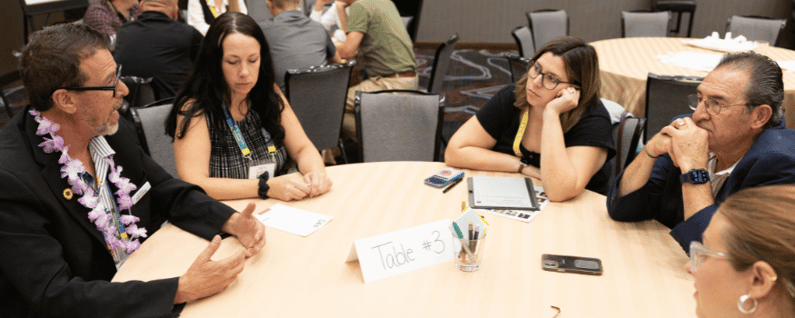
2. Round table layout.
- Best for: Collaborative discussions where everyone should have equal input.
- Why it works: A round table encourages everyone to participate equally and share ideas in a relaxed way.
- Ideal group size: 6-8 people.
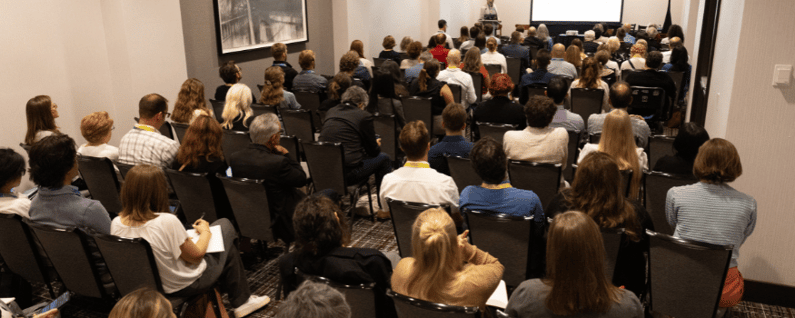
3. Classroom-style layout.
- Best for: Educational sessions or when you need people to take notes or focus on a speaker.
- Why it works: This setup keeps everyone facing the front, ideal for a more structured session where you’re delivering content.
- Ideal group size: 15-20 people.
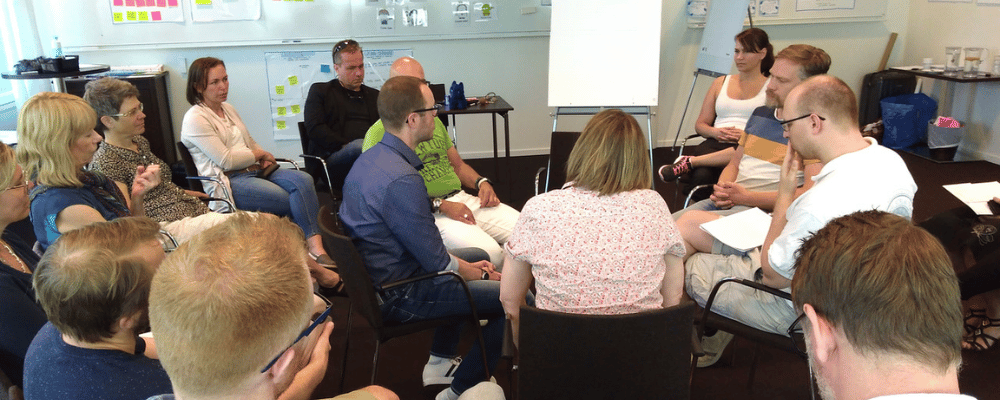
4. Fishbowl layout.
- Best for: Panel discussions or debates where a small group talks while others observe.
- Why it works: It gives participants a chance to discuss things in the center while the rest of the group can listen and even join in.
- Ideal group size: 5-10 people in the inner circle, with 20+ people as observers.
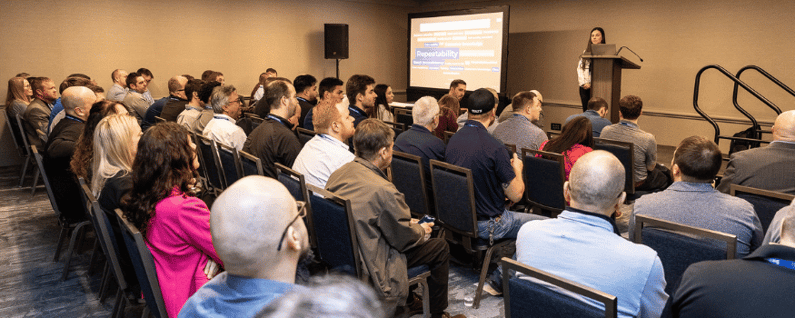
5. Theater-style layout.
- Best for: Larger presentations or sessions where people need to focus on a single speaker.
- Why it works: Everyone can see the speaker clearly, but there’s minimal group interaction.
- Ideal group size: 20+ people
Beyond the breakout room: whole-event floor plans.
Your breakout sessions live inside a bigger floor plan, and how you design the whole event space matters just as much. A few more layout styles to consider at that scale:
- Crescent rounds. Round tables with chairs on half or three-quarters of the circle, all facing forward. Good for general sessions that still need group discussion, since it keeps everyone facing the stage while still allowing for interaction.
- Mixed seating. A mix of lounge furniture, highboys, stools, and standard chairs in one space. Works well for networking areas where you want attendees to have options and move freely.
- Hub and spoke model. A central hub area with breakout rooms or experiences branching off it. Creates a "town square" feel and gives you a natural spot for sponsor booths, networking, and lounges.
- Exhibit-first layout. Build your flow around the expo or sponsor hall first, then add sessions and breakouts around it. This can help drive high traffic to sponsor booths.
- Silent theater zones. Several small stages sharing one open space, with attendees using headsets to hear their session. A creative, flexible alternative to traditional breakout rooms.
How your venue shapes what's possible.
Your floor plan only works if the venue supports it. Before locking in a space, check whether it actually fits your flow: look for flexibility to reconfigure rooms, and don't be afraid to use nontraditional spaces like rooftops, foyers, or outdoor lounges if they fit your event better than a standard ballroom.
Common floor plan mistakes.
- Designing for efficiency instead of experience. Maxing out headcount isn't the goal, what you want attendees to feel is.
- Accepting the default setup. Ask why the room is set the way it is, and whether that setup actually supports what you're trying to do.
- Ignoring who you're sharing the venue with. If another group is running a bigger production next door, your event may suffer by comparison.
- Not designing for downtime. Give people somewhere to go when they're not in a session, a lounge, a hub, or even just a charging station.
Using AI to brainstorm your layout.
If you need a starting point, AI tools can generate 2D or 3D mockups of your layout based on your objectives, venue specs, and attendee count, and can even simulate traffic flow or flag where sponsor activations might clog a walkway. Tools like ChatGPT, Gemini, or a Canva whiteboard are worth pulling up early, before you ever set foot in the space.

11. Wrap-up.
End your breakout session with a clear wrap-up that reinforces key takeaways and provides a space for reflection.
Summarize the main points discussed during the session and highlight any actionable steps participants can take moving forward.
Then after your wrap-up, spend a couple of minutes gathering feedback.
Quick methods like live polling, post-event surveys, or even a show of hands can be used to assess what participants found most valuable and where improvements could be made.
This real-time feedback will help you improve future sessions, making them even more effective.
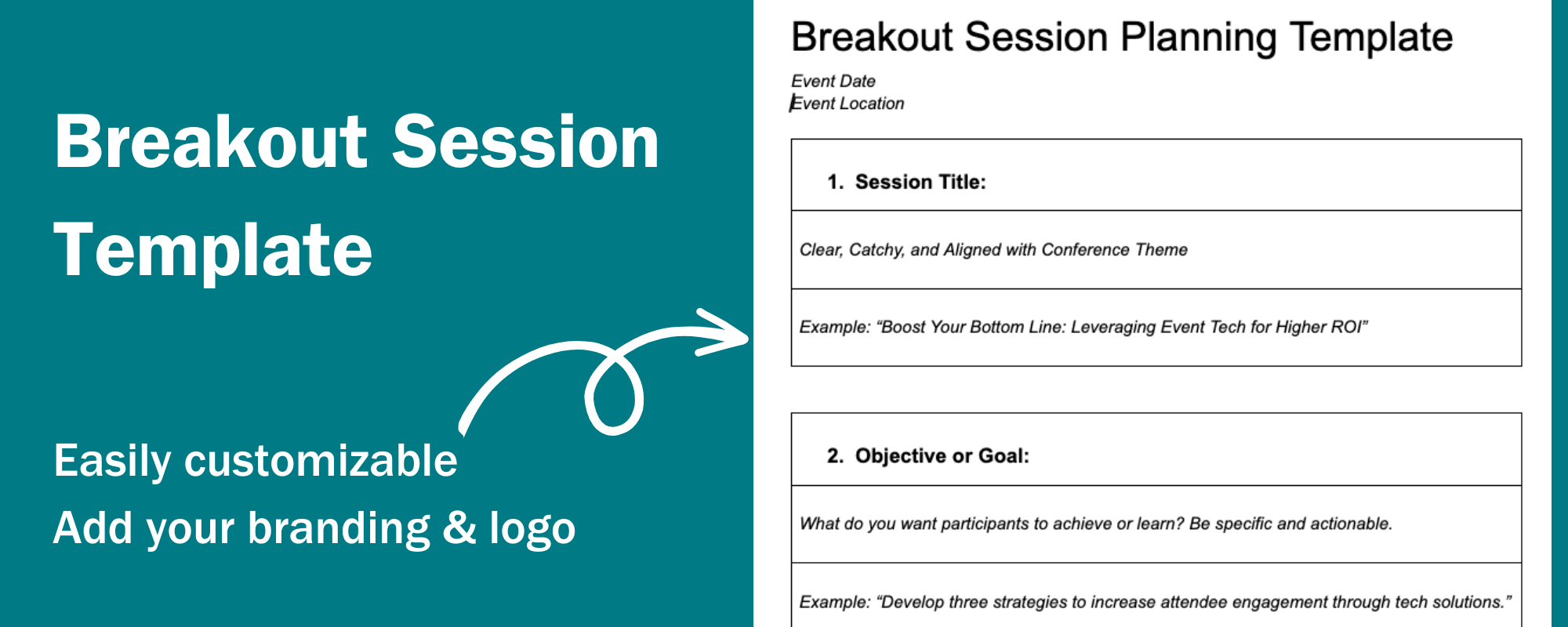
Breakout session template.
Use this template to help you plan and organize your breakout sessions for your next conference.
Simply follow the sections in this document, and fill in the details for your session. You can use this guide to craft a session that encourages active participation, delivers value to attendees, and helps achieve your conference goals.
Plan your next event with GoGather.
Need help structuring your next event agenda? Let’s talk about how GoGather can help you craft an unforgettable event that will make your next corporate gathering one you'll never forget.