

Enterprise event budgets rarely blow up overnight.
Most of the time, the overages build quietly during planning. A missed approval here. A rushed vendor add-on there. Food and beverage guarantees that stay untouched after registration shifts.
By the time leadership sees the final numbers, the budget already carries months of small decisions that never received a second look.
This article breaks down the behind-the-scenes planning gaps that quietly inflate enterprise event budgets and how you can catch them earlier.

Quick summary.
This is what we will be covering in each section of this article:
| Section | What it talks about |
| Your two biggest budget buckets are also your two biggest risks | A closer look at how F&B and A/V costs grow quickly when menus and vendor quotes are not challenged early in planning. |
| Lack of visibility is where overages become permanent | How inconsistent budget reviews allow small overages to stack up and become part of the program total. |
| Vendor sprawl is expensive, and most teams do not see it coming | Why adding too many vendors creates operational risk that leads to higher costs. |
| Time is money, and late decisions are expensive ones | How missed planning deadlines trigger premium pricing and overtime labor. |
| Scope changes stack up quietly | How small changes throughout the planning cycle add cost when teams do not document or offset them within the budget. |
| The biggest budgeting myth enterprise teams still believe | Why experienced planning partners often reduce program cost through contract oversight and full-budget visibility. |
| The one habit that would fix most of this | A simple discipline that keeps event budgets accurate throughout your planning cycle and prevents surprises at final reconciliation. |
Now let's take a closer look at where enterprise event budgets start to expand behind the scenes.

Your two biggest budget buckets are also your two biggest risks.
Every enterprise event budget has the same anatomy, and often the same weak points. F&B and A/V are consistently the largest line items, and they're also where the most preventable waste lives.
Here's what budget bleed looks like in each area:
Food & Beverage.
- Menu selections priced too high for the event type or audience
- Too many meal functions built into the agenda when one could be cut
- Bottled water and on-consumption sodas at every break instead of water stations
- Custom menus that forfeit the F&B discount built into your hotel concessions
- Headcount guarantees that don't account for the attendance fallout that always happens
Related: Here’s what factors affect your corporate event’s food and beverage budget.
Audio/Visual.
- Agenda timing that pushes A/V labor into overtime rates
- Equipment upgrades that don't actually serve the content or audience
- An incumbent vendor who hasn't been pushed to compete in years
- Accepting the in-house A/V quote without getting competitive bids from external providers
- For A/V, we recommend testing multiple competitive bids and including at least one external production provider to challenge the in-house default. This creates pricing pressure that benefits every line item downstream.
The fix for both starts before contract signing.
Related: How to take your conference audio visual production to the next level.

Lack of visibility is where overages become permanent.
Here's how budget problems compound: an overage happens in one area, no one catches it in time, and it quietly becomes the new normal for the program total. This is a financial visibility problem.
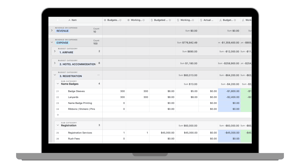
Managing a large event budget requires looking at it holistically, and often. The teams that stay on budget are the ones reviewing their budget frequently enough to react when something shifts.
What that looks like in practice:
- Budget reviews happen on a set cadence throughout your planning cycle (not only at kickoff and final reconciliation)
- Overages in one area trigger immediate conversations about where to offset in another
- Every team member touching a budget line understands the full picture, not only their slice
Incremental spend is the hardest kind to catch. A few hundred dollars here, a small upgrade there...none of it feels significant in the moment. But it stacks fast when no one is tracking your running total.
Related: Inflation’s got ahold of your conference? Here’s how to stay on budget.

Vendor sprawl is expensive, and most teams don't see it coming.
More vendors means more coordination, more risk, and more room for things to fall through the cracks. Managing them all at once creates a heavy operational load.
Think about what actually goes into bringing one vendor onsite: delivery windows, setup schedules, dock access, overnight security, teardown coordination. Multiply that by ten vendors who don't know each other and may have overlapping scopes. Then you have an operational problem that creates real financial exposure.
Where vendor sprawl does the most damage:
- Duplicated services that nobody caught because scopes were never compared side by side
- Vendors unfamiliar with the venue who need more hand-holding and time than anticipated
- Gaps in coverage when too many parties assume someone else is handling a detail
- No single person with full visibility into what every vendor is doing and when
You don't necessarily need fewer vendors to fix this issue. Sometimes your program scope requires a large team.
However, you do need a cross-vendor schedule to make sure every partner is aligned before anyone steps foot in your event venue. Pre-planning meetings and a clear chain of accountability keep vendor sprawl from becoming chaos.
Working with vendors you've used before or who come from trusted referrals matters. A new vendor who comes in cheap can cost more in managed risk and last-minute problem solving than a reliable partner at a slightly higher rate.
Related: Your strategic guide to sourcing the best event partners.

Time is money, and late decisions are expensive ones.
Planning timelines don't feel like a budget issue until they are. Delayed decisions create premium costs across almost every category, and most teams don't see it until the invoice arrives.
A few examples of how timing directly affects spend:
- Signage vendors will offer discounted rates when all work is approved 30 to 45 days out...anything past that triggers premium pricing
- F&B menus need to be locked in ahead of contracted deadlines, and guarantees can only flex 10% up or down from your initial number
- Service labor costs increase when scope isn't finalized early, because last-minute changes require expedited coordination
- Transportation contracts have specific terms that, if missed, can leave your group without a ride
Staying on top of contracted deadlines throughout your planning cycle is a direct line to cost control.
Related: Here are 6 habits of highly effective corporate meetings management teams.
Scope changes stack up quietly.
No enterprise event arrives onsite looking exactly the way it did in the original brief. Something always changes. This becomes a problem when those changes aren't tracked or offset somewhere else in the budget.
What good change management looks like:
- Every scope change gets documented and its cost impact is calculated immediately
- The client is informed of overages as they happen
- When a change adds cost, the planning team actively looks for a place to absorb it elsewhere in the program
- Onsite revisions are treated as budget events, not only logistical ones
One common pattern: something that looks perfectly adequate during pre-planning reveals a gap once you're walking the room onsite. A change gets made. It's the right call. But if no one connects that change to the budget, it becomes part of the unexplained overage that surfaces weeks later.
The better your budget management discipline throughout the planning cycle, the more flexibility you have to absorb those inevitable onsite moments without blowing your final number.
Related: Here are ten common event planning challenges and practical ways to solve them.
The biggest budgeting myth enterprise teams still believe.
Many enterprise teams assume that bringing in an external event planning partner adds cost to their program.
The reality is that a strong planning partner brings discipline to how your budget is managed.
Your event planning partner:
- Manages your budget strategically across the entire program
- Understands where amenities and concessions apply and where they do not
- Pushes the right vendors on price while protecting reliability
- Flags the F&B guarantee that never got updated
- Questions the A/V quote that has rolled forward unchanged for three years
On the financial side, your event management partner should also be:
- Reviewing the full program budget regularly and flagging where you're running over or under
- Negotiating vendor pricing with the context of the full program scope, not just one line item
- Cross-checking BEOs against the F&B plan to make sure nothing is missing or doubled
- Identifying where budget can be reallocated when overages appear in other areas
Your event planning partner pays for itself many times over. Teams that manage events in-house to save the management fee often spend far more in preventable waste than the fee would have cost.
Related: Still unsure? Here are the pros and cons of working with an event management agency.

The one habit that would fix most of this.
Update your budget continuously. Not once at kickoff. Not once at final reconciliation. Throughout your entire planning cycle.
Your budget should be reviewed and updated every time something changes, including when:
- A vendor contract is signed
- A planning deadline is reached
- A menu or F&B package is confirmed
- A vendor scope changes
- Registration numbers shift
- Sponsorship revenue comes in
This constant visibility is what keeps your event budget under control.
By doing this, you always know where your program stands, and you can react to an overage before it turns into a pattern. Most importantly, your leadership stays informed instead of being surprised at the end of your event.
Related: The CEO’s guide to planning impactful corporate events.
Ready to plan your next event?
We understand that enterprise events are complex. But your event budget should never feel like a mystery. Schedule a meeting with our planning team to talk about how you can plan your best event.